Fertilizer Calculator
Instantly calculate the exact amount of fertilizer you need in pounds and bags. Save money and prevent over-fertilizing your lawn and garden.
Was this calculator helpful?
How to Calculate Fertilizer
Measure the Area
Find the length and width of your lawn or garden bed. If it's a circle, measure straight across the middle (diameter).
Check the Bag Rate
Look at your fertilizer packaging to find the recommended application rate (usually listed as pounds per 1,000 sq ft).
Get Your Results
Enter the numbers above. We'll tell you exactly how many bags or total pounds you need, preventing chemical burn on your plants.
(Sq Ft Area ÷ 1,000) × Application Rate = Total Pounds
To find total pounds manually, you first find your square footage (Length × Width in feet). Since fertilizer application is almost always measured per 1,000 square feet, divide your total area by 1,000, then multiply by the application rate shown on your fertilizer bag.
Everything You Need to Know About Buying Fertilizer
Why Should You Measure Carefully?
Adding the exact right amount of fertilizer ensures maximum greening and root development. Guessing can lead to applying too much nitrogen, which causes "fertilizer burn" and damages your plants, or applying too little, yielding poor growth.
Understanding N-P-K Ratios
Every bag of fertilizer has three numbers (like 10-10-10). These represent Nitrogen (N) for green growth, Phosphorus (P) for root development, and Potassium (K) for overall plant health. Choose a ratio that matches your lawn or garden's specific needs.
Application Rates Explained
Most commercial fertilizers are applied at a rate of 2 to 4 pounds of product per 1,000 square feet of lawn. This generally delivers about 1 pound of actual nitrogen per 1,000 sq ft, which is the standard feeding rate for healthy turfgrass.
Using a Spreader
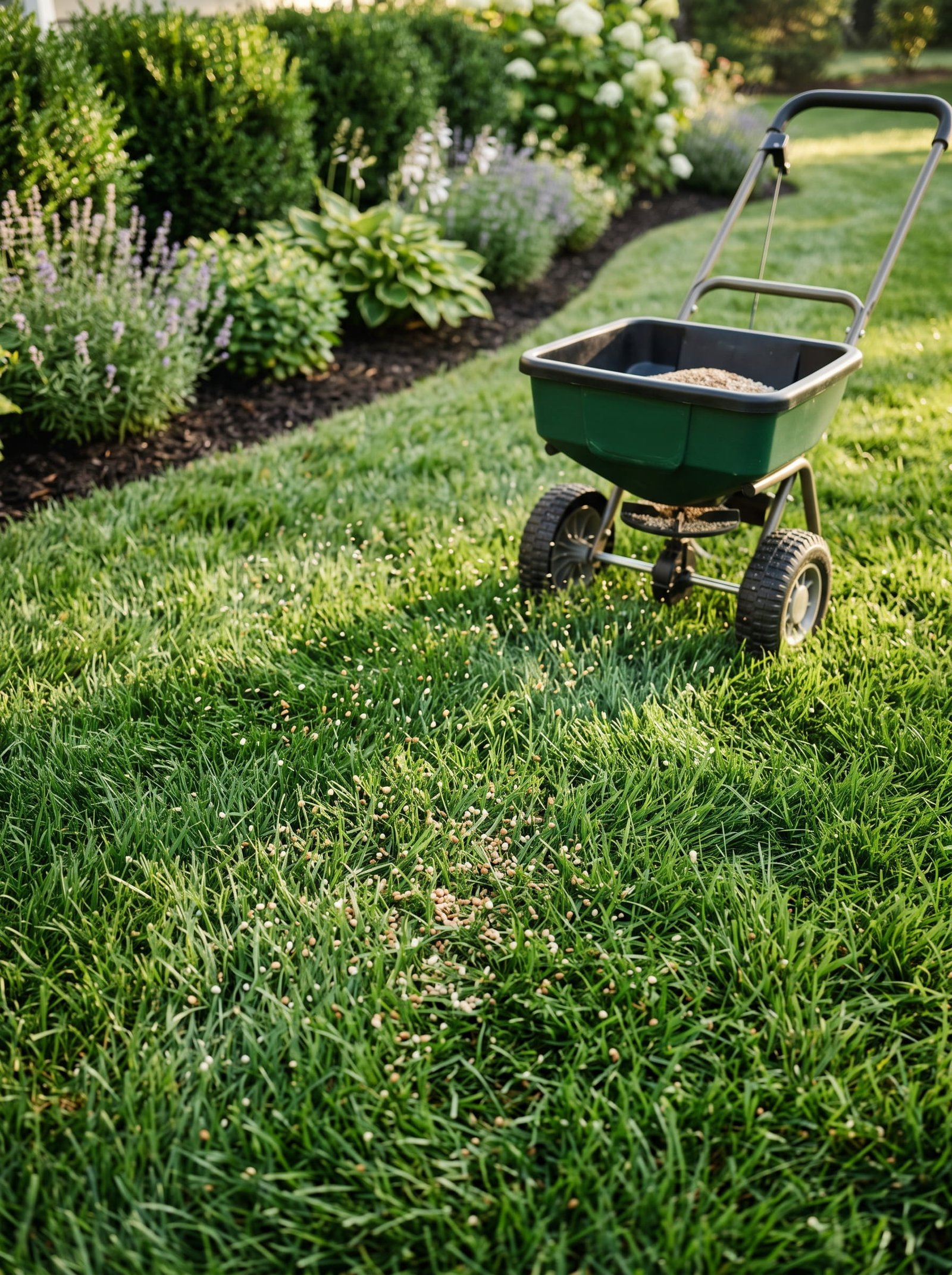
When applying granular fertilizer, always use a broadcast or drop spreader. Never apply by hand, as it causes uneven clumps that will burn patches of grass. Ensure your spreader dial is set according to the manufacturer's directions for your specific product.
Frequently Asked Questions
It depends on the product concentration. Generally, you want to apply 1 pound of actual nitrogen per 1,000 sq ft. For a product with 25% nitrogen (e.g., 25-0-4), you would apply 4 pounds of total product per 1,000 square feet.
Applying excessive fertilizer causes "fertilizer burn." The high concentration of nitrogen salts draws moisture out of the plant roots, turning the grass or leaves yellow or brown. Always use a calculator to determine the exact amount needed.
For cool-season grasses (fescue, bluegrass), apply in early spring and early fall. For warm-season grasses (Bermuda, Zoysia), apply during the active growing season in late spring through summer. Always water lightly after applying granular fertilizer.
Granular fertilizers provide a slow, steady release of nutrients over weeks or months, making them perfect for lawns. Liquid fertilizers are fast-acting but wash away quickly, making them ideal for a quick nutrient boost for garden plants and vegetables.
What Users Say
See how others are using our fertilizer calculator for their lawn care projects.
Super quick and easy. Confirmed exactly how many bags of weed & feed I needed for my lawn so I didn't end up burning my grass.
I love using this for my client's yards. The multiple areas tab is a fantastic feature when calculating complex lawn layouts.
Nice design. Figuring out exactly how many pounds to set my broadcast spreader for was a breeze.
This was incredibly accurate! It calculated my total pounds exactly right to match the 40lb bags at the hardware store.
A sleek and simple tool. Perfect for diving into the basics of lawn care instantly before heading to the garden center.
Love the modern look! The advanced options letting me input my bag weight saved me from over-buying.
More Lawn & Garden Calculators
Ready to start your landscaping project?
Stop guessing and start saving time.
Explore more calculators